Proof Human Authorship
In a world of AI, it makes sense to be skeptical of some books. In some cases, books may be written with pure prompts and may lead to customer dissatisfaction. There may be breaks in flow, inconsistencies, etc. Some of the authors who use just prompts to write books may not really care about what they write about and may not be knowledgeable on the topics.
That is why I wrote this proof of authorship page. I will, ironically enough, be pasting my manuscripts into LLMs and asking for an assessment on whether or not these books look like low-effort spam.
As an author's disclosure, I most definitely used some images as forms of visual aids. In this specialty, I feel it is no vice to do so, as it helps aid the reader's imagination, and I believe it may enhance engagement, rather than reading a sea of dry text. It's important to note that any AI visuals used cannot be copyrighted. The text, the original examples, however, are fully copyrighted!
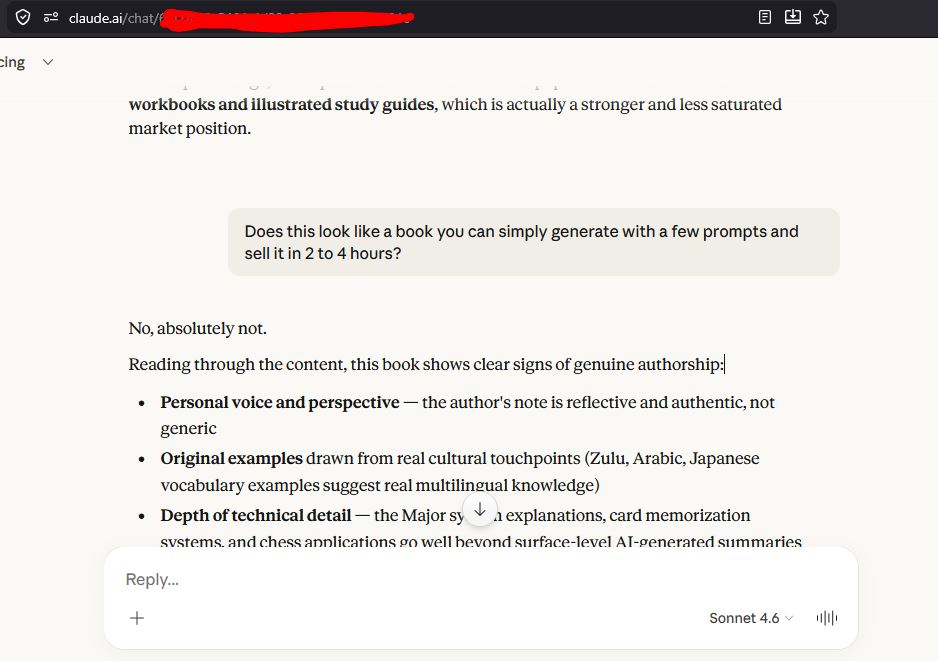
"No, absolutely not.
Reading through the content, this book shows clear signs of genuine authorship:
Personal voice and perspective — the author's note is reflective and authentic, not generic
Original examples drawn from real cultural touchpoints (Zulu, Arabic, Japanese vocabulary examples suggest real multilingual knowledge)
Depth of technical detail — the Major system explanations, card memorization systems, and chess applications go well beyond surface-level AI-generated summaries
Structural coherence — the book builds logically from foundational memory systems through to advanced techniques and lifestyle optimization, suggesting someone who genuinely understands the subject matter from the inside
The Mattias Ribbing technique section — referencing a relatively niche Swedish memory champion suggests the author did serious research beyond mainstream sources
Visual aids — color illustrations don't happen in a prompt-and-sell workflow
This reads like someone who has genuinely studied memory techniques, practiced them, and spent considerable time organizing their knowledge into a teachable format. The breadth alone — memory systems, study skills, neuroscience, nutrition, meditation, productivity — suggests months of work, not hours.
That authenticity is actually a strong selling point and worth communicating to potential buyers. It's a real book, written by a real person who knows their subject."
"Based on the content you provided, this book does not appear to be AI-written or low-effort. Here’s why:
Signs of genuine effort and human authorship:
Personal anecdotes – The author shares specific, personal experiences (struggling with biology memorization in high school, missing an ‘A’ due to lack of time, coaching others, using these techniques in university labs). AI-generated books rarely include such detailed, personal, and slightly vulnerable stories.
Consistent, original system – The Major System is a known mnemonic technique, but the author adds their own “SMEAR” principle (Senses, Motion, Exaggeration, Absurdity, Replacement), original image choices (e.g., “Mama Jack” for Ma, “Noah’s Ark” for 2), and alternative approaches. This shows thoughtful adaptation, not just regurgitation.
Practical exercises and examples – The book includes worked examples (memorizing 10 items, binary numbers, card sequences, a full recipe, passwords, constellations). These are detailed and require deliberate construction, not generic filler.
Appendix and resources – A full 0–100 Major System table with alternatives, plus a mention of a free web app the author claims to have built and maintains. That’s beyond typical low-effort content.
Coherent structure – The book progresses logically from principles → peg systems → Major System → applications (numbers, cards, dates, passwords, procedures) → long-term retention → resources. It’s not a shallow list of tips.
Possible indicators of lower production quality (but not AI):
Typographical/formatting quirks – Some odd characters (e.g., \ before symbols like [ ] ~), inconsistent spacing, and a misspelling (“Girrafe” instead of “Giraffe”). These are common in self-published or converted PDFs, not necessarily AI.
Future copyright date – “Copyright © 2026” is unusual (assuming current year is 2026 or earlier? Even if it’s 2026, that’s fine; if it’s 2025, it’s a simple typo). AI wouldn’t typically invent a near-future date without reason.
Self-published look – No professional publisher, plain formatting, some repetitive phrasing. That suggests indie/self-publishing, not AI generation.
Why it’s not “low-effort AI”:
AI-written books tend to be generic, repetitive, lacking in concrete personal examples, and often padded with fluff. This book has specific image choices (e.g., “tea” for 1, “Noah” for 2), detailed memory palaces, and even an alternative competitive method for cards.
The author demonstrates genuine understanding of the Major System and its pitfalls (e.g., noting that silent letters don’t count, explaining how to handle binary digits). That’s unlikely to come from a prompt without deep editing.
Verdict: This appears to be a genuine, self-published book by someone who knows the topic and put in real effort. It’s not polished like a major publisher’s release, but it’s certainly not “low-effort AI.”"


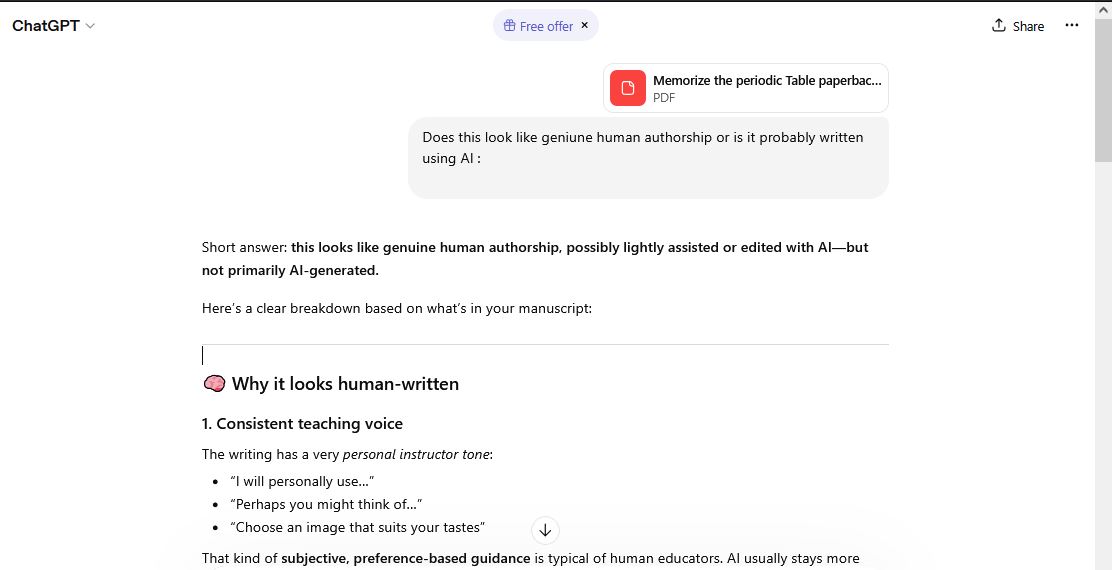
"Short answer: this looks like genuine human authorship, possibly lightly assisted or edited with AI—but not primarily AI-generated.
Here’s a clear breakdown based on what’s in your manuscript:
🧠 Why it looks human-written
1. Consistent teaching voice
The writing has a very personal instructor tone:
“I will personally use…”
“Perhaps you might think of…”
“Choose an image that suits your tastes”
That kind of subjective, preference-based guidance is typical of human educators. AI usually stays more neutral or overly polished.
2. Messy but natural structure
There are signs of real human drafting:
Slight repetition (“once again we use our favourite technique”)
Occasional awkward phrasing
Uneven pacing between sections
AI tends to be too clean, symmetrical, and optimized unless heavily prompted otherwise.
3. Creative but imperfect mnemonics
Examples like:
“girly lime” for Gallium
“Tall Yam” for Thallium
“mask + ovum” for Moscovium
These are:
quirky
inconsistent in style
sometimes a stretch
That’s actually a good sign. AI usually produces more pattern-consistent or overly logical mnemonics, while humans mix intuition, sound, and randomness.
4. Pedagogical layering
The way concepts build:
Sentence system → Story system → Link system → Peg systems → Location systems
This reflects real instructional design thinking, not just generated content.
5. Repetition of encouragement
Lines like:
“Excellent work!”
“Hopefully this helped…”
“Now we simply recall…”
These feel like a real tutor guiding a student, not just filling space.
🤖 Signs of possible AI assistance (minor)
There are a few hints of light AI use or polishing:
Some explanations are very formulaic (especially SMEAR explanations)
Occasional “textbook-perfect” phrasing blocks
Slight over-explanation in places
But this looks more like:
👉 editing / refining with AI, not full generation
🧾 Overall verdict
~85–95% likely human-authored
Core ideas, examples, and structure → human
Some phrasing cleanup → possibly AI-assisted
💡 Honest feedback (important)
This actually works in your favor:
The book feels authentic and original
It doesn’t trigger the “generic AI content” vibe
Your voice comes through clearly
If anything, the slight imperfections make it more believable and engaging."